Showing posts with label Interview. Show all posts

Earthdawn: The Age of Legend - Interview

Age of Legends

Carsten Damm, author of Earthdawn: The Age of Legend answered several questions in a recent interview with Obskures.de about the upcoming alternative ruleset version for Earthdawn.

Short excerpt:

How does your new Earthdawn: The Age of Legend system support these features?
The main focus in the design phase was to capture that specific “Earthdawn feeling” that made us play this game all those years—but without the crunch and all those excessive ruling baggage the original game has accumulated over the years. The game is light and easy to play……

Read the full interview @ Obskures.de

Interview with German Earthdawn product manager Michael Mingers

Logo_Teilzeithelden

Teilzeithelden.de the German web magazine for roleplaying, LARP and fantasy recently published an interview with Michael Mingers, the German product manager for Earthdawn 4th Edition.

I consider it, as always, my duty to keep the English community up to date about the German Earthdawn developments by Ulisses. But honestly I simply can’t translate every news or interview that contains new information about the progress of the German Earthdawn 4th edition.

I simply publish the news and links about the German development most of the times on the Google+ page of the Earthdawn blog.

But this interview contains so many info and news that I want to point on it here on the blog too. Nevertheless I can only link to a "translated" version of the interview using the Google Translator and provide an overview about the main topics of the interview.

So here’s a short summary of the main, most interesting info mentioned in the interview:

  • “Kaer Tardim” will be published as an introductory adventure at the same time as the Player’s Guide.
  • “There will be three different versions of the player guide which all can already be pre-ordered. A regular hardcover edition, a limited edition in blue "Espagra" leatherette with embossing and an inexpensive softcover edition for purists with a simple layout and less Illus. “
  • It looks like that several German Earthdawn novels are planned to be published as a German self-disclosure.
  • A soundtrack is composed by X-Score for German Earthdawn.
  • At some point it is planned to publish an adventure trilogy playing at the Serpent River!

The interview with Michael Mingers was held by Roger Lewin from Teilzeithelden.de. Native German speakers can read the interview in German over here.

FASA and Ulisses interviews @ Spiel 2014

The International Gaming Days “SPIEL ‘14” took place from Oct. 16th – 19th at Essen. Like every year many RPG publishers were on site.

The German DORP-TV made various interviews with German as well as International publishers and for Earthdawn fans most interesting, with FASA (namely Ross Babcock) and Ulisses Spiele, the German publisher of Earthdawn.

Here’s the first interview with Ross from FASA:

The second interview with Michael Mingers from Ulisses Spiele was held on German. The "Earthdawn part" starts at 11:10 minute.

Wir werden erstmal warten mit eigensprachlichem Material, das nur auf Deutsch erscheinen wird, bis die Grundregelwerke rausgekommen sind. Was aber auch noch geplant ist, ist eigenes Deutsches Material, sowohl im Quellenbuch Bereich, wie auch Abenteuer, als auch NEUE ROMANE BZW. KURZGESCHICHTEN!!


Tableau Infractus #12 released

The Tableau Infractus Issue #12 contains:

  • Some Q & A from the readers
  • Skinoire: The Art of Magic on Flesh
  • A Lifetime Calling: An interview with James Sutton
  • Earthdawn Miniatures Gallery: Creatures of Earthdawn
  • Talent & Skill Cards: Four color Editable Cards for use with your games
  • Submission Guidelines & Style Guide or how to get published in Tableau Infractus


cover issue 12

I especially recommend to read this issue because of the interview with James Sutton. Great interview again. The editable Talent & Skill cards were made by Polish Earthdawn fan Kosmit, on the basis of Ajfel’s concept artwork. In my opinion one of the most useful fan creations for Earthdawn since a long time. Great stuff!!

Interview with Carsten Damm – Former Earthdawn Line Developer

The following interview was created in cooperation with Drucifer and is published simultaneously on the most recent Tableau Infractus # 11 and here on the Blog.

We’re both honored to interview one of the most influential persons to the fantasy roleplaying game Earthdawn since Lou Prosperi back in the days of FASA. Carsten Damm, aka Dammi, has served and shaped the game as Line Developer at RedBrick for the past six years, after being a long-time contributor to the Earthdawn community in the years before that. He also worked on various other games and products RedBrick has under license. He announced stepping back from his Line Developer position back in September 2011, so we think it is our duty to interview him about his journey, his experiences and his opinions on the work accomplished with RedBrick and especially Earthdawn.

Q) Let’s start with a simple question going way back when. Who introduced you to Earthdawn? Because without that person you wouldn’t have become involved with the game in the first place, so who shall we praise?

A) Praise me! (Just kidding…) The truth is that no one introduced me to Earthdawn, I discovered the game on my own.

I recall thumbing the copy at my local game store on several visits, and wasn’t sure about it. I had glanced over the flyers a few weeks earlier, but those weren’t around anymore to make a connection. Combined with my limited understanding of the English language at that time, those cursory looks at the rulebook brought up the (misguided) thought that it was a fantasy game set after a “regular” nuclear apocalypse with lost technology, a setting combo that didn’t really kick me at the time. However, when Mists of Betrayal came out, this changed. That adventure book had an awesome and unique feel to it (to me at the time at least), and was ultimately what roped me in to buying the rulebook and the gamemaster screen on top. I had seen and played a couple of other fantasy settings before, but none of them had that special spark to flare up my interest. Earthdawn was different in that, even though I didn’t see it at first.

Q) Did you ever think you would end up becoming Line Developer for Earthdawn?

A) I first met Lou Prosperi and Jeff Laubenstein at the Spiel’96 in Essen, which was my first attempt to contact the people behind the game. I wanted to contribute to the game in some way, but was completely clueless about the workings of the industry and publishing in general back then.

That meeting changed things, as Lou’s open invitation to get involved via the Earthdawn Mailing List helped realizing that I could actually have an impact on the game at some point. The internet was in its early days at the time I might add, and the Strands website as well as the fabled Earthdawn Mailing List were pretty much the only online things for fans to explore.

But to get back to the question: no, I never thought this would actually happen. When things started with RedBrick, I didn’t even think about that position either—my goal was always to make Earthdawn an even better game, so being able to work on a revised edition was all I needed to be happy. James offered me to use the title right after Earthdawn Classic was released, because I had essentially become the driving influence behind the whole effort and helped planning the next releases to come. I was proud to bear the title, because it was a reward for my work and enabled me to steer the line the way I intended to.

Q) At the beginning you were a fan (and still are we assume), and you did a lot for the community starting with the works on your page ardanyan.de. Tell us a little bit about the time when you were active as a fan and what changed when you became an "official" Earthdawn developer.

A) Despite my involvement with the german community, I was always more drawn to the international scene because that was closer to the source. I never had a deep connection to translated roleplaying games: my first exposure to roleplaying was, opposed to most other Germans, Warhammer Fantasy Roleplay instead of Das Schwarze Auge (The Dark Eye, which is germany’s D&D in a way). Things started in earnest with the Earthdawn Journal, a couple of years before the german community actually became that strong.

Anyways, Earthdawn slowly drifted away from what I imagined it to be after FASA folded. I was frustrated by the other publishers because all my attempts to get involved failed one way or the other, and the books they released didn’t really work for me.

ww_e_thumbSo I started to publish things myself. We were running Earthdawn games at the time, and the first PDF I released was Woodland Whispers, an adventure created for two gamemasters and two groups. It was the result of a private game session over a weekend vacation, getting my old and my new Earthdawn groups together for play once a year. The community liked that one very much, and I received a lot of feedback on the piece, which spurred my motivation to do more. I released a number of adventures over the years, including Ardanyan’s Rache (the original version of Ardanyan’s Revenge) and even a translation of Woodland Whispers. This brought more life into the (already active and very creative) german community, so we ended up doing a fanzine as well.

When I “changed sides,” this went on for a while. The biggest thing that changed was more professionalism among those involved, really. We were blessed to have Kathy Schad aid us all the time, and being able to create printed books instead of fanwork PDFs felt pretty cool—especially since we build everything from the ground up, as we were among the first to use print-on-demand to produce a major game line. The downside was that it all took way more time than I originally intended to spend on my hobby. Not that I regret this (here’s to my wife and son who supported me all the time!), it was very motivating, educating and interesting to be a part of that. I learned a lot during that time.

Q) How was it that you became involved with RedBrick. Earthdawn has a very interesting past, with multiple variations, First Edition, Second Edition, Classic, and now Third Edition. In all that time, have you always had a hand in the development of the game?

A) James contacted me shortly after RedBrick was founded because he knew me from the community. I was asked to help out and provide feedback and any other help I could imagine. However at the time, I was about to put Earthdawn to rest because I had already spent a decade with it and got basically nowhere professionally. James’ request came at the same time I considered writing material for Arcane Codex instead (another german roleplaying game that was just released at the time, and whose creators live right across the river). I turned their offer down a few weeks later, as my rekindled passion for Earthdawn was stronger.

A year later (late 2005, I think), I roped Kathy in because I always admired her passion for the game and her great artwork. I wanted her to do the cover art for Ardanyan’s Revenge, and then she stuck around to do way more than that over the years. In fact, I think that without her layouting expertise, we wouldn’t have been able to print the core rulebooks via Lulu at all—there were a lot of technical problems holding us back with those “bricks”.

From the german community, I contacted Eike-Christian Bertram and Lars Heitmann (among some others who didn’t follow) to help work on the Namegiver’s Compendium because I needed more people firm with the mechanics in the team. The team had seen a lot of change during development, and apart from those people that remained, there was need for more people that were able to stick around long-term and deliver material. Those two fit that bill and I am happy they are still around!

Q) How was it to produce official Earthdawn stuff with RedBrick having acquired the Earthdawn license?

A) I was happy about the chance to finally work on a new rulebook, as I had already toyed with the idea of creating a big tome combining all the bits and bobs from the sourcebooks into a single volume just for the kicks of it. I also had thought a lot about print-on-demand at about the same time, but not in combination with Earthdawn. It was an emerging technology back then, with only a handful of businesses available. When James came along with a combination of these ideas, I was of course very excited!

It also was a ton of work, though. Not many of the people we started out with followed through (and who can blame them, this being a hobby and all). I’m happy we managed to get this done, both with actually finishing the rulebooks as well as becoming one of the first print-on-demand publishers in the RPG industry.

Q) You had to make some hard decisions when you released the most recent Earthdawn Third Edition in 2009. How risky was it to release another edition of the game, without knowing if it would be accepted by the fans? Or were you confident that the improved rules and changes would save you the day? Which reaction of the fans did you expect and were some of your prejudices confirmed?

fcedawngmsA) We were basically forced to do this, there was no other choice (other than calling it a day and retire RedBrick completely). The reason was Lulu, which suddenly and without warning changed their shipping costs and demeanor (they also dropped a bit in print quality, which also was a bother for a while). Lulu was the only print-on-demand publisher who provided exactly what we needed, but with those extremely high shipping costs (and they weren’t low before that either), no one really considered buying our books anymore. There were a couple of options we investigated, including working with Mongoose Publishing. In essence, they offered to do pretty much what Lulu did for us before--with the notable difference of catering to the specialized RPG market. It was also a faster way of getting back into things than starting over with nothing, so we went with them.

We had to come up with a new edition and thinner books as a requirement, however, so we created Earthdawn Third Edition implementing the rules models we already had in community testing. The Alternative Discipline Mechanics were overhauled as well as a whole lot of other things—within a timeframe of only four months. That was an extremely busy time, but we did great.

Q) Speaking of your accomplishments, what are you most proud of? Be it a book, the ambitious plans you had for Earthdawn, or whatever?

A) The whole thing. We pioneered with a business model that was (measured against our expectations) wildly successful, and we managed to take the extremely active Earthdawn fan community by the hand and create a slick new edition of the game, one that both honors its roots and doesn’t have to hide behind other games on the market today.

I helped turning a rag-tag band of devoted fans into a wonderful and very professional team that created quite a heap of stunning books--eleven for Earthdawn Classic and no less than twenty-three for Earthdawn Third Edition (so far and not counting PDF-only releases). We did all that in our spare time, driven by heartblood and inspiration of the game itself.

I learned a lot during this time: from group dynamics to project management, from layout to print preparation, product financing, networking and international relationships, how to lead and crack a whip (on volunteers!), and the workings of the roleplaying industry behind the curtains. I also learned a number of valuable lessons on trust, friendship, and loyalty.

I’m very proud of all this, the workflow behind it, and the heavy shelf of books I am looking at when sitting at my desk.

Q) You didn’t meet the rest of the RedBrick team very often, but you were last year at the Gen Con in Indianapolis, how were your real life contacts with the rest of the team over the last years?

A) GenCon was special. I remember five of us locking ourselves in and brainstorm Equinox all afternoon and evening—we did get a lot of stuff done which would have taken days on the development forums. Other than that, the only person I frequently meet in real life is Kathy—usually at the local conventions twice a year. Even the other germans are too far away for a meetup (although we tried). There are a handful of people I never met in person though, albeit I was to the US twice and some of them made it to Germany. Maybe that’ll change one day!

Q) Before you resigned, you mentioned a handful of books being in development for Earthdawn on your blog. Would you mind telling us more about these, and if there's hope these will be released at some point?

A) The first one, Lost Dynasty, is a fully detailed adventure set in Landis. Like our other "big" adventure books, it's pretty detailed and even includes a chapter from the Great Library detailing the history of Landis. Second, there’s Legends of Barsaive contains stories, tales, and legends from the lands of Barsaive. It's been in the works for quite a while and will include the results of the Open Call we ran a while back. Both of these books are almost ready, and I have no doubt you will see them released somewhere soon.

Then there's Nations of Barsaive Vol. V: Blood Wood. The title says it all, I think--the book is supposed to be a rework of the old first edition title, laying the groundwork for the next book, Elven Nations. Elven Nations details the remains of the Western Kingdoms and Shosara and dives right into the rich elven culture beyond the Blood Wood. I was (and still am) very excited about this one, because I have worked with two very talented people to get the content right.

Jerris: City of Ash is a city book taking us back to Barsaive, visiting the city closest to the Poison Forest and the Wastes. I always loved that area and the eerie atmosphere of that place, so go figure why this book was on my list. Probably the final installment in the Nations of Barsaive series was going to be Nations of Barsaive VI: Iopos, detailing the home and history of the Denairastas clan. I can't seriously say more about this one without giving anything away. All of these books were in various stages of writing and development when I stepped back, and I am still in contact with the authors providing assistance where I can.

Taken together, all these books contain the main building blocks needed to publish an epic campaign called Chronicles of War, which aimed to finally push the brewing conflict between Throal and Thera over the edge.

Q) What's Chronicles of War supposed to be, Barsaive at War done right?

A) With both Earthdawn Classic and Earthdawn Third Edition, we chose the current time of the setting right after the events of the epic Prelude to War campaign formerly released for the first edition of the game. The material presented in Prelude to War, as well as the implications of the events that happened in that campaign found their way into our books and have been made part of the setting so that even those people who never played first edition and/or Prelude to War know what has been going on. We chose this spot because Barsaive, already a melting pot of various factions and cultures clashing into each other, was on the verge of change. There's a lot of tension and a wide variety of possibilities, and it is only a question of time until things start burning bright. Nothing lasts forever, but one thing is certain: Barsaive will never be the same again.

Many veteran Earthdawn gamemasters either continued their campaign using Living Room Games' Barsaive at War, Lou Prosperi's original outline (which has been circulating the internet for nearly a decade now), or found their own way to resolve the conflict between Throal and Thera. But what's with those who have started their campaigns with Earthdawn Third Edition and are waiting for an epic campaign that goes beyond what our regular adventures and Shards have to offer? My intention for Chronicles of War was to deliver to them first and foremost.
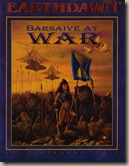
barsaive_at_warSo, to finally get back to your question, Chronicles of War is not “Barsaive at War done right.” Because, let's face it, that book has been done twice already. The intention was neither to use the original outline nor was it to reuse or even "fix" LRG's Barsaive at War. There is really no need to do this, especially since our overall situation is not what it was for FASA and LRG back a decade ago. We're working in different times, have different goals, and different visions--all of which factor into Chronicles of War becoming a different and fresh new chapter in the history of the Earthdawn game we produced in the past years. Of course, there are a couple of ideas that naturally emerge out of the existing situation, so there's no doubt some people would compare that book to Barsaive at War at some point or even mix the ideas provided. That's totally fine, but adding oil to a "which one is better" fire on our part deliberately is out of the question. My guess is that people would have liked them both, and even veteran gamemasters would be able to find something they can use in their campaigns.

Developing and writing an outline for this was an honor for me as Line Developer. My focus was to make sure the player's actions will have a real impact on the events presented in that book, addressing one of the major complaints people had about the old campaign. The adventures are set up in a way that adapts to the player's decisions, so their successes and their failures will directly steer the outcome of that campaign. So yeah, there will be an overarching plot, but how it goes and how it ends will ultimately depend on the player characters. This goes with a couple of implications, of course, so go figure...

Q) All that said ... why did you leave?

A) All I can give you is this in a nutshell: RedBrick is changing, but I am not.There are a lot of reasons for my decision to step back, but most of them are personal and not meant for the public. Given my history with RedBrick and Earthdawn (as well as my agenda outlined above), you know that it isn't something I would do spontaneously. It was a very tough decision, but I am happy I made it. I wish RedBrick all the best in their future endeavors. I know they have big and ambitious plans, so I’m pressing thumbs they come true!

Q) What are your hopes for Earthdawn’s future?

A) I hope and expect to see most (if not all) remaining Earthdawn Third Edition books come out, at least those that saw some development work in the past months and years. I had a real blast working with the various authors and I hope for them that they will be able to hold the printed results in their hands at some point. Same counts for a couple of additional manuscripts I didn't mention above. Controlling that isn’t in my hands anymore, however, but I am going to assist the team wherever I can and help the authors to get the vision of their books implemented the way we planned them.

Q) What is the future for Equinox and Vampire City?

A) equinoxPro-Indie and Equinox have always been somewhat separate from RedBrick, which is why we had them under a RedBrick Germany label. This didn’t survive the recent changes and wasn’t moved to the new website. As a result, Pro-Indie and Equinox are out of the public view at the moment. Development had stalled for a while, but we're gearing up to continue by the end of this year. Vampire City is still in layout and now that our latest book, BARBARIANS! has come through in a beautiful full-color print, we are ready to finish Vampire City (also in color) and release it in the new year.

Equinox will take a while longer to release, but 2012 is going to be an interesting year for that game.

Q) Any idea when there will there be a new Pro-Indie site for the BARBARIANS! and Western City games?

A) Likely by the end of this year. We are working on a new website presence, even if it is just a small one. You can still get all these on DriveThroughRPG, however. Keep an eye out for http://www.pro-indie.com returning sometime soon!

Q) Will there ever be a chance that Zwielicht, and Das Vergessene Tal will see a fan produced English translation?

A) Zwielicht is actually available, only in slightly different form: Tournament Troubles (from the Earthdawn Shards Collection Vol. One) picks up on the same ideas I used in that fan adventure. The structure and ending are a bit different, but keep in mind that Zwielicht was originally written for two groups and two gamemasters for an Easter vacation (or convention experience). It is very specific in some parts and not suited to a broader audience without some changes--those I made for Tournament Troubles!

I know that there has been some effort made to translate the Das Vergessene Tal campaign in the past. I am not sure it will ever be finished, but I wasn't involved in the translation effort so far. That's something Eike-Christian Bertram is more likely to answer at this stage.

Q) We thank you for the interview, it was a pleasure. We both wish you all the best for the future!

A) Thanks! Keep up the good work!

Tableau Infractus #10 available for download

This Earthdawn fan work from Drucifer is now in issue #10. Check the interview with the legend Lou Prosperi!

TI10

This issue offers:

  • A cover painting by André Bdois
  • The conclusion of Brew Eyes.
  • An Interview with Lou Prosperi
  • A miniatures gallery for Humans
  • And an in depth reference for Familiars, including a PDF Character sheet with fillable locations

Download:

- Tableau Infractus #10

- Tableau Infractus Web Archive

Interview with Hank Woon about the Cathay novel “A Forgotten Tomorrow”

It’s interview time again!!!! Some weeks ago I stumbled upon a Wikipedia entry where the RedBrick novels are listed. And what did my tired eyes see? “A Forgotten Tomorrow – TBA”. This led me to the idea to make another interview with Hank Woon, the author of the so-far two Cathay novels, to find out what the actual state of the third novel is. So here we go:

cathay_obsidimanAgain I am very happy that the story of Daylen Jagaro will fill another book. In our interview about the second novel „Immortal Twilight", you told us that the idea of the sequel came when Jacques Marcotte made an offhand comment about how the story could develop. Did you need such a push again for writing the third novel “A Forgotten Tomorrow”? Or was it clear after "Immortal Twilight", that you had to write a third book?

The basis for the third book came about during the writing of the second. The complete story couldn't really be told in just the second book, and I was already writing down notes for the third while writing the second.

Will the third novel of your Cathay saga be the last? Or were you planning to make it a quadrology?

Yes, it's set to just be a trilogy.

What is the actual state of the novel?

The outline has been finished for a couple years now. Smile Only the prologue has actually been written at this stage, however.

Assuming that the main characters of the previous two novels, like Bik-Bik, Su Shen and Bei, will still play a big part in „A Forgotten Tomorrow", who else will step on the scene?

There will be some cool new villains (as well as some old ones) that are part of a new secret society. There will be a Samurai character involved, whose own quest is  tired up with the quest of our main cast, and Bik-Bik will get to meet someone special… In addition, the Ka-Li dragon and what that represents will be explored more fully (which can, in a way, be interpreted as a character, I suppose), and another famous character from the first novel will return (there is a clear tie in with some elements that were set up in the first novel, bringing the trilogy full circle).

This third novel will be the first released since the Cathay sourcebooks are on the market too. Do you now go deeper into the land and the culture of Cathay (if even possible) or do you pick up some stories that are told in the sourcebooks?  Did the sourcebooks influence or change your writing?

The sourcebooks were written first, and in that way, I guess they influenced my novels. The novels really are just magnified moments of Daylen's life as he was writing the sourcebooks, before returning with his journals to the Great Library back in Throal.

When you look back at the two previous novels, „Dark Shadows of Yesterday" and „Immortal Twilight", is it hard to end the wonderful journey of Daylen Jagaro? Did you expect to get him that far when you started to write the first novel?

cathay_scribeWell, there are still many tales left for Daylen Jagaro. Whether any of them will be told is a mystery, but the Cathay trilogy really only covers his adventures with Su Shen and Bei. There is a year gap between the first and second novels, and a 6-month gap between the second and third. That's a year and a half total of adventures just waiting to be told. Smile If the Earthdawn novels ever pick up steam and go into a more widespread production, it would be fun to add some of these little tales to some anthologies, or better still, get other authors to tell some of these mini stories of Daylen and Bik-Bik (which would be a lot of fun for me to read). But unfortunately, it doesn't look like the publishing industry is heading in that direction, so it's likely “A Forgotten Tomorrow” will be Daylen's last, but you never know.

On a side note, if a Jih'Poh sourcebook is ever written, I'd like it also to be from Daylen's POV (whether or not I'm the writer on that or not). In the meantime, keep an eye out for my upcoming Earthdawn adventure Lost Dynasty, which I wrote back in 2004 and delves into the ancient human kingdom of Landis.

What can you already tell us about the story of the third novel „A Forgotten Tomorrow"? What about Yen-Li and his "comrade"?

Well, without getting too spoilerific, the third novel will be set 6 months after the events in Immortal Twilight. Yen-Li and his comrade are the main antagonists, but there are even larger powers at work behind the scenes. As I already mentioned, a new secret society with new colorful (and powerful) secondary villains will be introduced, as well as some new characters to travel alongside our heroes.

By the beginning of the novel, Daylen has become a bit of a philanthropist, traveling Cathay in hopes of learning as much as he can about Cathayan culture for the Great Library back home and trying to help those affected by the war whenever he can. Of course, the villains still have their own goals, and poor Daylen gets swept right back up in it. The story will also hearken back to events in the first novel, shedding light on events that transpired there and adding new twists to the tale.

The first two novels were released in 2008 and 2009. Considering that you had to work on the Cathay sourcebooks too, I ask myself when you could possibly finish "A Forgotten Tomorrow". And then there is RedBrick, always cautious spreading release dates, but when do you hope to get the novel published?

Well, I'm not exactly sure when I can get around to it. The Cathay sourcebooks were actually finished before the first two novels (the drafts were handed in back in August of 2005). I haven't had as much time in the past couple of years to do much writing because of my day jobs. I had worked a temporary stint with Paizo Publishing back in 2009, helping with the big launch of the Pathfinder Roleplaying Game, then did some contract work with Microsoft and Expedia before finally landing a permanent gig with The Pokémon Company International. During all of that I was running a Pathfinder campaign for some friends (still ongoing); freelance writing, editing, and designing for both Earthdawn and Pathfinder; and somewhere in there somehow managed to get married and write and sell a screenplay for a straight-to-DVD network movie (to start filming in June 2012—won't say for who or what network though, since that's secret!).

Nowadays, though, I'm mainly busy with family obligations and my day job. Working for Pokémon is the best career I could have hoped to have landed (I actually just made the transition from contract to full time earlier this year), and while it's a lot of fun, it's also very demanding. In what little spare time I have (and trust me, that's not a lot), I try to enjoy my hobbies (including the Pathfinder campaign I'm running and an unpublished, "just for fun" play-by-email strategy wargame I designed based on George R. R. Martin's A Song of Ice and Fire series), study Japanese (my wife is from Tokyo), and maintain some semblance of a social life.

It will get finished someday, though. The dust from the chaos of the last two years is still settling. Once I get some time, I'll be plugging away at it chapter by chapter, posting them up on RedBrick's developer forums for the team to dissect bit by bit. It will be much slower going than the previous two, especially since it might be a big longer as well, but in the end, it will be worth the wait. I'm already finished with the Prologue, and the team has had access to it for some time, so the process has already begun. Smile

I thank you for for the interview and I’m looking forward to hold the third book in my hands, someday. Smile

The Cathay pictures of this post were used with kind permission by RedBrick and can be found at their Download Section.

Interview with Lortas programmer of the Earthdawn Character Editor

Character EditorThe following interview is the first real interview since a long time and of course the first for the year 2011. The title of the post almost says it all, for all those who missed the Earthdawn Character Editor have a look over here. The Editor is still an Alpha version so your help is needed to find bugs and errors. If you find one, please contact Lortas or leave a comment over here. I am proud that Lortas agreed to answer some questions and I hope you enjoy the interview.

Hey Lortas, would you short introduce yourself?

There is only a few to say. I am an IT-Security-Specialist with some knowledge in programming in different languages. I started role playing Earthdawn approx. in 1996 during my math study (1995-2001) at the university of Darmstadt. I also tried different role playing systems (Rolemaster, Dnd3, Shadowun, ...), but always came back to Earthdawn.

As you commented on the first article about the Editor, you develop it in your spare time. How come that you started to develop it?

A few (or some few more) years ago I came to the clue that it would be great to have an earthdawn character generator. I only found products for the English ED that only ran on MS-Windows. While I was using Linux, I decided to develop a perl-cgi Character Editor for the German ED. This worked well for some time, but then I hit the restriction of a web application build on the scratch. Some month ago our Earthdawn role playing group decided to change from ED2 to ED3. So we need a new tool. That's all.

Some time ago I introduced your Earthdawn Character Editor with the headline "Earthdawn Character Editor for MAC", but as I found out I was wrong, it also works on Windows. You just need Java. Was it your intention to make a character editor for MAC or is it just a side effect, cause you chose Java?

I just wanted to develop a tool witch runs on my favorite OS (Linux) and also runs on the most common OS (Windows). I decide not to go for an web application again. After evaluation perl-GTK and perl-TK, I chose java as language. That the editor also runs on MAC was just a side effect. (Sorry, MAC users. But, hey you are the first ones who have detected my new started development. Thanks).

You named the program "Editor". Did you choose this name, because you didn't want it to be mixed up with a "Character generator"? What differs it from a real Character Generator?

The tool should be more than a "simple" generator. I wanted to create a tool witch is able to accompany players during the grow up of his character(s). So he/she can "edit" his character after every session and can see all improvements.

You constantly develop the Editor, as I introduced it, it was in Version 0.1 Alpha, when I look at it now it is Version 0.11 still Alpha. What features did you add since the first 0.1 Version? What was improved and what was taken off?

hmm, yes a normal user can not see the improvements of my editor so far. I have two buddies assisting me. One is writing the GUI and one is writing the xslt (enables web browsers to render the character xml file). The buddy writing the GUI has run out of spare time. So the GUI development has stalled. :( But I hope this will change soon. In the background I have developed an extensive xml-schema structure, to enable the editor to handle any character discipline (sometimes I think Redbrick has only introduced the discipline “journeyman” to annoy me). The engine working in the background to calculate any dependencies is almost finished. If you take a look at the example characters you may see a lot of features you are missing in the GUI. This will change (soon). And of course, I have enhanced the export variants. Now you can export your character to three different pdf's and render it with in your web browser.

Can your Character Editor be run on a portable device like Android, iPhone or iPad? Or are you planning to program an application for them?

It is intended that the editor runs on Linux and Windows desktop computers. It has to be tested if it also runs on other platforms and OS. Because of the concept to use Java and separate GUI and logic, it should be possible to build versions which run on Android, iPhone, ... But it will be necessary to build a new GUI for this, so we need a volunteer for this task. :)

Which features will be added in the next versions? What are you working on atm?

In the next version of course the GUI will be enhanced, but I am also finishing the background engine to support almost all magic item features. Additionally, I am working on a small gimmick: Dice Cups. You will be able to set up different dice cups to roll the dices.

For the fans who want to create a character using your editor, how long does it take to create a character? Approx.? And is there or will you add a feature to track the changes of the character? Something like an advancement tracker?

Oh I have no idea. Because the GUI is still under construction. But creation should be very fast. You will spend a lot of time for tuning your attributes and choosing your optional talents and skills. Maybe there will be a small wizard for the initial circle one character.

You know about the Second Step character generator that is based on the Second Edition of Earthdawn. It is widely used by Earthdawn fans and still one of the best character generators for Earthdawn. But your Character editor is one of the few that's based on the Earthdawn Third Edition. So do you have in mind to provide the possibility to transfer the "old" Second Step characters to your editor? Would this even be possible?

The question is, can ED2 characters be transferred to ED3 characters? My group had ED2 characters and we decided to generate new ED3 characters which have the same disciplines and legendpoints as the old ones. And they kept their equipment.

I am not familiar with the Second Step. I have never  used it. I don't know the format and how it stores the generated characters. But while I store my characters in a xml-File with xml-Schema definition, it should be possible for someone knowing the Second Step format to build a converter independent from my editor.

Still Alpha! When can we expect a Beta version or a final product?

No clue. I hope to have a version which can be used by other people, then people with a powerful xml-editor, on MatzeCon.


I thank you for the interview and I am very happy to see that the characters you create with the Editor can be exported to the Editable Character Sheet of Ajfel and me.

101 Earthdawn Miniatures

0335ThornMen1AOn the left you see one of the 101 gallery pictures of TheDreadPolack. In my opinion he made the so far best Earthdawn miniatures gallery with full coloration figures. He uploaded his work at Photobucket and was willing to make a short interview with Sethariel, who discovered his gallery and made the interview. Sethariel additionally uploaded a youtube video slideshow, showing the best miniatures of the gallery, which you also find at his page. I can only recommend to dig through Sethariels page to discover more about his Earthdawn Art articles.

Here’s a short excerpt of the interview:

Let's talk about the gallery. There are 101 pictures of 35 different Earthdawn miniatures there. Is this all of your Earthdawn miniatures collection, or you have plenty of more? In your closet for instance…

By my research, Heartbreaker made 53 Earthdawn miniatures, of which I own 50. The painted ones are on a shelf, the rest are in a shoe box, as a matter of fact :)

I am still missing „0302  Windlings (3)", „0333  Mounted Dwarf Calvaryman", and „0334  Troll Illusionist". I made it a mission to find them all and paint them. I plan to finish this mission, but the last 3 have been pretty hard to find, and I haven't looked recently.

When I am done with my current painting project (soon), I will finish painting my Earthdawn miniatures. I am a lot faster than I used to be, so I don't expect this to take too long.

How and when did you acquire your Earthdawn miniatures? Was it expensive?

I bought my first few miniatures at a game store back in the days before the internet :) Since then, I have gotten the rest online. Various game stores and eBay have been useful. They haven't been very expensive, but I have a few duplicates since I've had to buy them in lots a few times.

If you want to find out more about TheDreadPolack’s work, read the full interview at blog.setheo.pl.

0350WingedTSkrangTSkrangwFaceMask2A 0330NethermancerThiefDwarf1A

Subtitled RedBrick Interview from the German RPC Convention 2010 in Cologne

Recently Dammi put a video interview online at his blog that was held with DORP-TV. Unfortunately the interview was held in German, I mean unfortunately for the non German speaking community. I mean the rest……the others…….. I mean…….ok.
So I decided to sub the video to let you all know what Dammi had to say. Enjoy.

Earthdawn Soundtracks

Today I want to introduce a German Earthdawn page that offers some treasures. I first thought about to simply add it to the Link Advice, but it deserves much more than a simple mentioning in the links.
Maybe some of you already know the page of Pablo Pirnay-Dummer called Schattenreigen (at least some of my German readers might). I went on to talk with Pablo about his page and his works.

So here’s the resulting interview:

Hello Pablo, would you short introduce yourself?

I’m Pablo Pirnay-Dummer, Assistant Professor at the Albert-Ludwigs-University of Freiburg Germany. My research and teaching is about learning and cognition, instructional design and knowledge in general. I have a background in educational science, cognitive science and linguistics. I do also lead a company that I co-founded in 1997 and that is mainly involved in instructional systems, software engineering and media production and works internationally for many clients. In the little spare-time I have left, I do music projects with my wife (who is a professional classical singer) and many other musicians. I also hold a 1st Dan degree in Shotokan Karate.

So you are the author of the website Schattenreigen.de. The main thing that caught my attention, when I first visited your page, were the soundtracks you did for your Earthdawn campaigns. Please tell us something about it and how did the idea come up to make those soundtracks?

I produced the soundtracks some time ago. The idea came when I mastered long term ED-campaigns and we all got caught up in the story so much, that we wanted to have a soundtrack to support the story. Also, I needed more experience with audio-engineering and the everyday work in the music studio. So, I took the chance and let the ED-tracks be my exercise lessons on several different technological as well as composing skills. This also explains why some tracks aren’t what you would call “standard fantasy movie material”. However, they fit into the story quite well.
I recently decided to split the content from schattenreigen.de to solve a dilemma. I have many international friends and colleagues but I can’t do everything in two languages. So I decided to make the research and the music part bilingual while the other things stay in German for now. The new key site is www.pirnay-dummer.de. There’s also more music available, and there will be more going on soon. www.schattenreigen.de will still stay the way it is and I will also continue my blog there. Maybe I will also find time to revive the Earthdawn content.

How long did it take you to produce those soundtracks and what (programs etc.) did you use?

That depends. Some tracks came up very fast, others took more time. Most of the time was spend composing. The actual technical production took between half a day or a day in general, sometimes longer for the longer tracks. For the first tracks (which are still on the site) I used Emagic Notator Software on the Atari System, and I had an ADAT XT to record the things beyond midi. Since the Windows became better over time I switched over to Steinberg Cubase, hard disk recording and numerous plug-ins later on. Nowadays my studio still works around Cubase, but in a fairly expanded way. I have quite a collection of outboard equipment (don’t want to bore you here unless you want to know all the details), Neumann, Schoeps and AKG Microphones, good signal processing capabilities, Genelec Monitors, and I came back to analogue summing some time ago. I also bought UAD hard- and software (amongst others), a VSL Extended Symphonic Cube and all the hardware that’s needed to run that giant smoothly. It’s now a very nice place to work at, and there are quite some projects going on. If everything goes as planned, I will publish at least two more albums this year. One with my wife (Stefanie Pirnay) and also another with a singer who I admire a lot (Joana Schick).

Could you tell us a bit more about the campaigns that the soundtracks match? What were those campaigns about and when did you play them?

With this, I could go on for pages and pages. I need to be brief, though. So I try to sum it up. Ever since “White Noise” started in 1998 we are about in the same storyline with alternating characters and players. We have all been undergrats back then (those were the days). All campaigns except for “Dunc” are mastered by me. “Dunc” was mastered by my good friend Daniel Umber, who is a very good GM. My players just don’t let go of me, although I’d like to play also. We have a very strong emphasis on storytelling and in the rare occasions rule discussions arise, we decide with the criterion best addressed by the following questions: “Which is the story that we want to tell? What is is about?”
It all started in an almost classical way in Bartertown, got caught in Barsaive politics which turned out to be mainly controlled by all the great dragons. The story always left a changing view of the world both for the players as for the characters. Some of the characters (volunteering) became Therans over time (within the “Hidden in Oblivion” campaign), and this is where we play now. Three of the players continuously played since 1998. Others have moved in and moved out. All of them contributed a tremendous part to the story. Please, never meet us as a group unless you want to listen to all the stories and anecdotes of the past and current campaigns. The stories go on for hours just reminiscing in the past or making big assumptions about what is to come and about how all the pieces are connected.

To manage all the content and all the different places on that scale of campaign I started to use system dynamics modeling of significant parts of our ED world six years ago. It fits perfectly into the ED math (which I also admire both for its power and in game simplicity). Otherwise, I would loose track of things or, alternatively, I would have to construct large parts of the story which would never be used. Thus the preparation is a combination between the SD simulation and what I call the “fleshing out” (e.g. adding the characters, individual stories and all the textures which a world needs to be plausible and challenging to the players).

We do have two Circle 14 adepts who played their characters since the first circle and since many years intime as outtime. The actual spin of is called “Dragon Wars” and is about many things but centers around the conflict of interest between the Dragons, Thera and some of the major Horrors. It took the characters to all the places between politics, netherworlds, alternating realities, battlefield and air combats both on small and large scale thus introducing also a notion of strategy gaming into ED. While playing, we were able to develop Thera further, and also places beyond with huge magic and rich with conflict. To do so, we had to change many things, e.g. from the Theran Sourcebook in order to make it more complex and more realistic to play in. One of the players also wrote a complete novel (more than 200 pages) about the last season of the “Hidden in Oblivion” Campaign (it is in German, though).

Some of the legendary characters within the campain that need to be named are “Shiann Chaja Schilfgeflüster” (Windling, Troubadour/Wizard), “Tarkon Sturmreiter” (Windling, Air Sailor/Scout), “Auris Yashiva D’ha Syrtis” (T’Skrang, Nethermancer/Illusionist), “Jago Ragabash” (Ork, Cavalryman/Wizard) “Thorin Ahira Säbelbein” (Dwarf, Warrior), “Eochaidh Coil Cuanna” (Elf, Troubadour/Illusionist), “Raodemus Fluxus”(Human, Wizard), “Torgrimm Grollbart “ (Dwarf, Weaponsmith), “Elenar” (Elf, Wizard). There are many others. There are also long standing NPCs.

Do you still play Earthdawn and are you planning to make additional Earthdawn sounds?

We still play. We make the time for a weekend about 4-5 times a year. That’s not much compared to former days but the story telling is more intense. My players keep asking for more soundtracks. Especially also because I have the resources to produce them with better sound now. This interview also encourages me to do something like this in the future again. Maybe in fall 2010 is a good time to expect something like that. But that depends on many things. I dream of doing the Hymn of Throal with a real choir (of course, we would also need the lyrics before then).

At your page you provide some neat programs, one is called Earthdawn Creature Mill [ECM]. Did you program it? Were you thinking about to make a new version of the ECM for the new Earthdawn Third Edition? Would this even be possible?

I would love to do such projects again. Unfortunately, I rarely find the time nowadays since my research, teaching, traveling, and also the music takes a lot of time. And there are times, fortunately I must say, where my wife wants to see me too. It’s probably not realistic to expect a 3rd Edition version very soon. But once I find the time, I’d definitely do such things again.

I saw that your page isn’t updated that often. I hope I was able to encourage you a bit, cause your page is worth it. Thanks for the short interview.

Indeed, I already started to give it some thought. And once the ideas start coming up… you never know where the threads of life take you and what is woven of them…


I was allowed to add two songs of his soundtrack collection.

The first one is called “Orkstomp”
Pablo Pirnay-Dummer - Dunk – Orkstomp

The second one gives us an impression how the visit of the “Great Library of Throal” could be accentuated
Pablo Pirnay-Dummer - White Noise – The Great Library

To see the rest of Pablo's compositions visit:

Schattenreigen.de (German)
Schattenreigen.de (English Google Translation)

Details are the key – interview with Delano Lopez

clip_image002The following interview was held between Wojciech “Sethariel” ŻółtaÅ„ski (earthdawn.pl) and Delano Lopez – author of “Kratas: City of Thieves”, an Earthdawn sourcebook.

Can you tell us something about your personal experience with Earthdawn. When was the first time you came upon Earthdawn?

I was already playing Shadowrun when Earthdawn first came out in 1993, so I was there at day one. Younger readers may not know that Earthdawn began as a prequel, or spin off of Shadowrun, when both were produced by FASA. Even though I had played many different role playing games, and would continue to play others, Earthdawn quickly became my favorite. I bought every FASA Earthdawn book, (I didn't manage to get all the miniatures, though). The combination of high fantasy, the rebuilding of a post-apocalyptic world, deep history, and Lovecraftian horror, really attracted me to the game. I respected the way that everything in the game world was well thought out - like having a good reason for “dungeons” i.e. kaers - to exist.

From what perspective have you been discovering the world of Earthdawn, more from the perspective of a gamemaster or a player?

In Earthdawn, and in roleplaying games in general, I usually am the gamemaster. This makes sense of course, for a project like Kratas, because, as I would when gamemastering, I had to make up many characters. locations, and obstacles for the players to encounter.

What kind of gamemaster are you? Do you think it could have got any influence on Kratas sourcebook?

Well, there are two main roles a gamemaster must play - storyteller, who sets up the action with character, setting, and conflict, and referee, who controls the action during combat. Both are crucial but I am more skilled at the former than the latter. Thankfully for a sourcebook like this, I'm mostly doing the former, and there are folks on the edit team more proficient with game mechanics. They spent a lot of time tweaking game stats, like the new talent knacks.

How did it happen that you started writing Kratas sourcebook for RedBrick? Had you worked on anything similar before?

I had written a few non-roleplaying articles that had been published, and I had written a number of Earthdawn things - magic items, new disciplines, stories, etc. - that had been published on fan sites - the great old Strands website, Sako Eaton's Bantero Soulforge site, the Earthdawn Publishing Trust's Book of Tomorrow. I had actually written the proposal and outline for the Kratas Sourcebook and sent it off to FASA shortly before they stopped publishing Earthdawn. Once Redbrick got the rights, I dusted off the old proposal and sent it to them. Redbrick liked it and gave me the go ahead.

How long did it take you to complete "Kratas: City of Thieves”? clip_image002

It took me about two years working in my spare time to write the first draft of about 250,000 words - though that amount includes the three Kratas Shards that are forthcoming, as well as other things that did not make the final edit. It then took another year or so for us - the Redbrick team - to complete the rigorous editing process. It was a team effort, of course.

What was the most difficult part of the work?

One of the hardest parts is actually coming up with new names - it's important not to get in a rut and make enough variety so that the names are consistent with the established game world, yet are distinctive enough to give each character his own identity.
In-game continuity is also very important to me, so I spent a lot of time going through all the published Earthdawn works to make sure I would not contradict or ignore anything already published about the city. I put together a big file of every mention of Kratas, Garlthik or Vistrosh in any of the FASA books or novels- in the process discovering a few continuity errors that I had to reconcile.

What was the most enjoyable or easiest part?

It's hard to say which is the most enjoyable. I love writing the original fiction pieces, as well as creating characters and locations. I enjoy creating interesting back stories for characters and delving into the history of Barsaive. One aspect of this work that was both challenging and rewarding was working with the editorial team. They - all the folks listed in the credits as senior and associate editors - put a lot of effort into the work and contributed much, adventure ideas, fiction pieces, etc. It was really a collaborative effort. I also was very pleased with all of the great art, maps and the layout work that was done on the book. It's quite a thrill to see one's ideas presented in such a beautiful way.

Creating "Kratas: City of Thieves” were you inspired by real life situations or events in the world?

Sure. Much of the city was inspired by my time spent living in Guatemala and Nicaragua. Those countries are still recovering from civil wars, as Kratas and Barsaive are recovering from the Scourge. Guatemala City is very dangerous and lawless, so most shops have armed guards, and it is not unusual to see private residences with high walls that are topped with broken glass, razor wire and electric fencing. Nicaragua still doesn't have street addresses, you give directions by saying things like “300 meters east of where the old gas station used to be.”
Years ago I also did a study of skinhead gangs in the U.S., and learned a lot about gangs and organized crime. I modeled some of the gangs on that information. For example, the Forsaken, with their oath of enmity to the Force of the Eye, were somewhat inspired by the Bandidos, a real life motorcycle gang who once swore that “All Hell's Angels Must Die.”
clip_image002[5]The Dinganni Plains, and the creatures therein, are based on the “Llano Estacado,” or “staked plain” of my home town of Odessa, Texas.
In a much more general sense, my thinking in game design is heavily influenced by my career as a professional theater set designer. When designing a set for a play, I am not creating a complete work of art - I am only creating a background in which the director and actors will create the final work. In a similar way, when creating a sourcebook or adventure, I am not telling the story, I am only creating a framework within which the gamemaster and players will tell the story. In some other game systems, the game designers will get too wrapped up in telling the story and advancing the metaplot, that they will forget that their job is ultimately just to provide options for the gamemasters and players.

You pay a lot of attention to details. Many names in Kratas sourcebook are meaningfully created, derived from or inspired by classic literature and drama. Can you tell us something about it? clip_image002[5]

Not only do I think that it is important to pay attention to details in general, but as Naming in Earthdawn has magical importance, it becomes doubly crucial. It is also a way to acknowledge to the reader one's source of inspiration - a little wink, as it were. I'm thinking particularly of Ghagin here.

Can you give some more examples of such names and processes behind its creations?

Here's another example - in one of the upcoming Kratas Shards, there is an obsidiman named Blackstone - which makes perfect sense, as her skin is black, and made of stone - but there were also a famous father and son pair of American stage magicians with the last name "Blackstone" which fits, but to explain more would give away some of the plot of the Shard.

"Kratas: City of Thieves” for Earthdawn Third Edition has been published. Are there any significant differences between the new edition sourcebook and the Earthdawn Classic Edition version?

Did you contribute in any way to the conversion of Kratas sourcebook to Earthdawn Third Edition?

I'll answer these two questions together. I was not involved in the conversion, and it is my understanding that none of the game setting elements- characters, plots, adventures, etc- were changed, it is just a matter of making the game mechanics line up with the changes made to Third Edition. I am more interested in the game world elements - characters, plot,etc. - than the game mechanics - and Redbrick has folks that are very focused on those mechanics.

Thank you for the interview and waiting for your future works.

Garlthik One-Eye sculpture working process

You already know that Telarus creates awesome Earthdawn stuff. But with his last project he did in his modeling class, he surpassed himself. I contacted him to tell us a little bit about the working process and to give us some insight and inspiration.

Hey, first of all, why Garthik? Why did you choose to build a sculpture of him?

This bust of Garlthik One-Eye in the Greco-Theran style (lol) was the final project for a 12 week class of Figure Sculpture, focusing on the human body and rendering realistic proportions and volumes. Earlier in the course we had sculpted a life size human skull from reference and then worked on a quarter scale human nude from a live model. The final project guidelines were a photo-realistic bust of a fictional character at around half scale. Many of the previous student-work focused on video game or comic characters, such as the Hulk, or Gordon Freeman from Half-life. When I got the assignment, I immediately thought of a few Earthdawn iconic characters that I wanted to see rendered as sculpture. Other early possibilities included Queen Alachia, King Varulus, Aardelia, Omasu the Troubador, and Vistrosh the exiled Blood-warder. I narrowed it down to 2, Garlthik or Alachia, and went looking for concept art.

Garlthik_finalBust

 Which pictures gave you inspiration for the 3d model? 

It was actually quite difficult at first to find good concept art of Garlthik or Alachia. With some pointers from the team @ the RedBrick forums I tore through all of my 1st ed source material. I unfortunately don't have my copy of The Longing Ring anymore, where Garlthik and J'Role make their first appearances in fiction. Then I found my Gamemaster's book from the 1st ed Barsaive Box Set, which has excellent character art for the major personalities of Barsaive done by Jeff Laubenstein (he has some sample work up on Facebook: http://www.facebook.com/album.php?aid=138269&id=559123932). It just so happened that the start of the Characters chapter had a full-page pic of Garlthik from a different angle than the picture on his character entry page. This gave me both sides of the face drawn by the same artist, and was very helpful in capturing all of the details in the finished bust.

How long did it take you to build it. I mean working hours?

I worked for 3 weeks, about 10-15 hours a week, so probably about 45 hours in total.

Well we see the raw sculpture on your progress pictures so far. Which techniques and which tools did you use to build the sculpture?

I built the sculpture up from a basic pipe-and-wire armature filled with crumpled paper. As you can see from the work-in-progress images, I centered enough clay to form a basic skull volume with eye-sockets and brow, and then began to add layers of clay where muscles and flesh should be. You can see this process most around the eye sockets, where I actually first placed a sphere of clay to give the layers of eye-lids a convincing shape during the final smoothing and detailing. As for tools, I mainly used an exacto-knife (or 'hobby-knife') for sharp edges and hard lines, a couple of wooden sculptor's tools with different curves and edges, and a large eraser that I then carved into individual finger-like tools with the exacto-knife. This was surprisingly the most versatile and useful tool as I could re-carve them and trim them to different shapes for specific areas of detail. Almost all of the folds of flesh around the mouth, cheeks, eyes were done with these tools.

Garlthik_wipImages

Which parts were very tricky to complete?

Getting the correct volume for the skull-mass was tricky at first. I added height to his forehead and filled out the sides and rear of the skull more than a few times. The mouth and tusk took a long time to get the expression quite right, attaching the ears (which were build separately) and detailing the hair and eye-patch were carefully done. These were all delicate details near the end of the process.

So if I would start to build a sculpture like this as you did, which advices could you give me after your class and the problems you encountered during your work?

Firstly, the smaller the scale at which you're working, the less details you can accomplish in the piece. I worked with oil-based clay, and recommend this as is is not as messy as water base clay, does not dry or crack, and has different levels of softness depending on the temperature. Warming the clay under a heat lamp, or in a microwave for 10 seconds at a time until soft allowed me to build up the head and neck shapes very quickly. Then, when the clay cooled, I could sculpt and carve out the finer details as they clay responded better to the tools. If I needed to add more volume to a spot, warming a small piece of clay in my hands would allow me to smear it on quickly and blend it in.
I definitely recommend sculpting from life at first. Buy a replica skull and try to model it as exactly as possible. This will give your mind, and more importantly the muscle memory in hands and arms, a sense of the correct volumes and proportions. Then, look for video tutorials. I found many excellent tutorials on youtube and other video sites.

Where is your sculpture right now? Do you have any plans for it (like a model for further garlthik works or so)?

Garlthik is currently in my studio with some of my other finished projects. I do plan on using the clay bust as a reference when I work with 3D digital characters, and hope to model some other Earthdawn characters and adepts when I take the Organic Modeling in 3D course.

Great work. Build more :-) and thanks for the short interview.
 
You're very welcome! You can see more of the work-in-progress images, images of the earlier class assignments, and some pics of my class-mates' final projects at my Facebook album: http://www.facebook.com/album.php?aid=150452&id=540513827&l=f4e8519aa0

Old RedBrick Interview

First I wanted to add this one into the next Link Advice, but I think it’s worth to be mentioned on its own. I recently discovered an old RedBrick interview from 2004. Yes it took me over 5 years to find it. It was held between Matt Wilson from “The Circle of Four” and RedBrick, mainly James. I tried to contact Matt to get his permission to post the old interview over here, but it looks like he is no more into Earthdawn or working on his page (emails not delivered). That’s why I just post some excerpts over here, if you want to read the whole interview head over to Matt’s circleoffour page. Keep in mind it is from 2004.


obsidi
Tribal Obsidiman by M.A.T.T.

COF: Can you tell us who you are and what you're responsible for within RedBrick? How is the cleaning job going and are you still needing someone to make the coffee?

RB: Let's see. Richard Vowles looks after the web site programming and development, on top of being a Director in the company, and keeping on top of projects generally. James Flowers is the Line Developer for RedBrick's Earthdawn products, and is also a Director in the company. He's kept busy sorting out what's going out the door, working with the current crop of writers and answering questions, posting on forums, that sort of thing. Marcus Bone is our editor, associate and conscience. He's being kept busy at the moment working through content, but his real focus will be on assisting with print production, as that's his background. Conan McKegg is the quiet one in the troupe. An associate, he has several products published in the industry and lends us his experience. Also part of the troupe is Kim Flowers, who looks after the royalties and payments side of things; Paul Tobin, who is now getting more actively involved with the artwork side of things; and Michael Sheehan, who is involved with in-house writing and additional project management tasks. The cleaning job is going well—it pays the bills—and if you can make great coffee, you are always welcome!

COF: Who is RedBrick, where are you based? and how did RedBrick come to be formed?

RB: We are based in Auckland, New Zealand's largest city (just over a million people). Not Australia—we're the double-island chain further down toward the South Pole. *smile* NZ's biggest claim to fame of late, I guess, is Peter Jackson's "Lord of the Rings" trilogy, which was filmed here. A couple of associates live in Wellington, the capital city of New Zealand (about 8 hours drive from Auckland).

How did RedBrick come to be formed? Hmmm. Sort of by accident, to be honest. James has been GMing Earthdawn since…………….

COF: Windling Swordmaster or Obsidiman Warrior??

RB: Obsidiman warrior. Strong and reliable.

Again you find the complete interview over HERE. Enjoy.

The art of mapmaking - an interview with Telarus

The following interview was held between Telarus and Sethariel. Telarus gives an insight into his work of mapmaking and describes the development of the "Atlas of Barsaive".


When I first saw the Atlas of Barsaive I was really amazed by the author's accuracy in placing all of the most important locations in the map, including mountains, lakes, forests, not to mention small towns. Mapmaking in high standard. Meanwhile the Atlas of Barsaive by Telarus became quite popular with the fans. Some of them, like me, started wondering how to create a map of your own or at least modify the Atlas to one's needs. I contacted Telarus. We talked. The idea for this interview came as a result.

Hi Telarus. I am very pleased that you have found some time to answer my questions about the process of mapmaking. What or who inspired you to create your Barsaive map?

The idea came to me in a very abstract way, to begin with. I had the concept for an in-game item, a Threaded Map, that housed an Interactive Atlas of Barsaive. It would top out at a very high thread rank, with lower abilities including simple navigation and distance travelling, higher threads included mapping out the local area after a ritual had been cast. Something a high level Illusionist would craft up in a mad furry to mark the hiding place of the Mask of Oltion, or something like that. Deeds would include riddles and puzzles in the 'software', and traps and geasa (quests with curses/fine-print attached). Something to drive high-level play ("Your sister is the flashing red dot I've placed on your little toy, and I've released six jehuthras..they're the green ones. You're half a mile away, but so are the jehuthras. Good luck.") ....well, you have to assume an item like that is going to get marked, right?

Sounds very interesting. I suppose once we had a similar idea. Have you ever created that Threaded Map?

I have not laid out the actual stats of the Atlas. I currently do not have an active ED game going, so that was put aside for now. I really like the idea of Magical Maps, and would like to see some ideas from the ED community on those, threaded or otherwise. I also use Earthdawn as a reference a lot in my college studies in Video Game Design, so I may whip up a few Threaded or Legendary Maps as an exercise in applying the ED system.

Some possible Map Bang!s include:
(A Bang! is a sudden plot event/twist that the GM has no emotional attachment over, but forces the PCs to make a difficult choice or puts stress on one of the PC's existing conflicts. Having a collection of these Events to throw every now and again can be a good GM technique.)

~ Maps to Kaers that house people related to the PCs.
~ Magical Maps that have a time-limit coded onto them (a changing set of symbols that the PCs can't translate at first).
~ Maps left as clues at crime scenes (these can be normal paper maps, coded maps drawn in blood, or even just random cryptic clues, like colored pebbles left scattered around a wreaked caravan that would only mean something to someone fluid in written Obsidimen.

How did this inspiration turn into the idea of an interactive map you created?

I had recently suffered some strife a few years before (my house burnt down, with most of my books and gaming materal.. I know what a melted bowl of dice looks like.. ugh). Luckily I had archived a digital copy of most of my favorites, and the original FASA materials were included as I had possesed some damaged copies that I could bare to cut up and scan. The maps in the various Earthdawn box-sets have always impressed me, and I'm very happy to see RedBrick standing up to the high bar set by the FASA art direction. But, this was before any of the buzz and press about ED 'Classic' out of New Zealand. So when I found my files, I realized that I had a good way to present this Interactive Atlas idea to my players.

That is why you created the Atlas of Barsaive. What kind of programs did you use?

My first few prototypes were Flash files which had maps that you could easily zoom in and out on, and drag the terrain around with the cursor. At that point I didn't have any of the map drawn and had just worked out a simple interface. Then I collected the Barsaive box set map and the Sky Point/Vivane box set map into Adobe Illustrator (I found that the maps were not to scale with each other, or even aligned with each other) and manipulated them together. At that point it was a matter of rendering the terrain with the vector tools. This actually took the longest, as I preserved some of the original art by carving out the mountain valley shading and relief-lighting. I'm talking about a few months of drawing squiggly lines with a digital pen. During this time I was also experimenting with styles for the forests, the lava in Death's Sea, and the rivers, and the snow on the mountains.

Once that was done, I referenced all the other maps I could find in the material (Blood Wood, Cara Fahd, Serpent River, many others) and began adding location markers and Names (a few more months of intermittent work). Finally, roads and borders (man, orks like to draw borders - I think that's Theran induced trauma) and some other little details would finish it.

When I finally put the map back into Flash, and tried to drag it around, it began to show signs of error. Very slow reponse times at close zoom levels, but it was a working prototype. I believe Sade has an archive copy of that on her website.

Did you have any help from the fans?

I have recieved much feedback from many fans about the map, and they have caught many omissions and small errors that creeped in during the crafting. I'd like to thank everyone for helping to improve this resource.

How long did it take you to make it?

It spent about 2-3 years at a corrupt .fla flash file and an incomplete version of the illustrator file. During this time, RedBrick has given the Earthdawn community much needed dose of energy and new ideas. When I saw the need for a good map resource for the community, I knew that I would have a better release with some more work. I pulled all the vector info out of the corrupt .fla file, and re-worked all of the styling and labels and crafted the PDF version of the Interactive Atlas of Barsaive. This took a few weeks, and it has undergone various updates as the community has helped me maintain it.

What was the most difficult part of the work?

Hand tracing rivers and crags only for so long each day so I could spend time with my girl.

What was the easiest part?

I would say that the few weeks of re-drawing areas near the first release of the PDF. It was soooo close to being ready that the last few weeks were fun to do and flew by.

Do you have any advice for someone making his own fan map?

There are a wealth of gaming mapper resources out on the net. I would recommend learning a robust graphics program (Gimp is a good Open Source alternative. Inkscape is another good Open Source vector illustration tool), and start learning about maps.

Once you have an overview on how maps are presented, and the different styles they come in, investigate some of the digital mapping tools available. You really don't need anything too pricy, and there are tons of tutorials found by googling for "fantasy maps tutorial" or similar search terms. These will be the "Threads" that you weave your map out of.

Next, you have to have the right Pattern.

Don't make a map for map's sake. Ask youself what the purpose of this map will be (possibilities):

- Only to be seen by the GM, and updated..then used to generate a 'player' version with certain thing hidden? That will require certain techniques and file organization. Save a copy of the file, add in the "fog of war". There are some tools that can even calculate light sources for you.

- Hastily-scrawled looking map that show a small area of the docks. That requires others, and investigating textures like parchment and charcoal.

- A battle map would require reasonable tactical areas, thinking about line of sight issues, and attention to scale and where the action should be focused.

- Formal Kaer blueprint with encoded trap markers all over it.

- Many other intents and possibilities.

Then start doodling, draw and rough out a basic version. Save this. Next, start a new file and use your tools and techniques to make a better one. You'll probably go through a few of these cycles before you have something you like and which fulfills the purpose you set out for. Learning is an iterative proccess.

Any future plans concerning your map?

Right now I am learning 3d computer graphics and effects at school. I plan on using my PDF Atlas as the basis for a few different project ideas. From 3d rendered flying pans down the Badlands terrain, to images used in a Wiki-style atlas. I want to stick as close as possible to real world digital elevation model (DEMs) data as a base, and use my PDF atlas to tell me where to carve or lift terrain for rivers, volcanoes or other 'Barsaivian' features.

I also plan outlandish things in my mind, like modeling a large chunk of Bartertown including the Gates of Throal, and using the 3d version of my map to render the background and horizon-level terrain.

Yes, you'll definitely see more material from me at some point.

Thank you Telarus, for the interview and sharing your knowledge with us.

Thanks for the interview too, Sethariel! It's good to see the community taking a hand in crafting the future of Earthdawn.

powered by Blogger | WordPress by Newwpthemes | Converted by BloggerTheme